


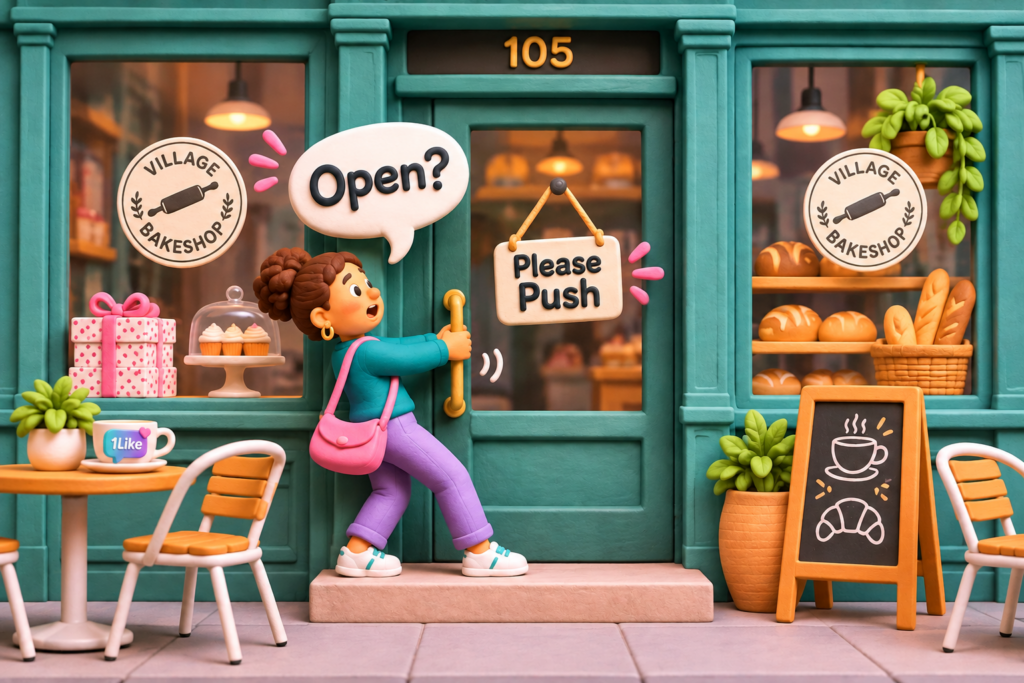
We’ve all encountered a door like this. It has a large, inviting handle that practically begs to be pulled. So you pull. Nothing happens. You pull harder, feel a slight flush of embarrassment, and then notice the tiny sign that says PUSH!!!
The shop owner has watched this happen hundreds of times. At some point they stuck up the sign, then a bigger sign, then perhaps an arrow. Customers still pull.
It’s tempting to conclude that people simply don’t pay attention. But the more interesting explanation is that the door is lying to them. The handle says “pull”. The sign says “push”. And when design and instructions disagree, people believe the design almost every time.
Here’s what Im saying:
- Affordance: What an object allows someone to do. A door can be pushed or pulled, depending on its mechanism.
- Signifier: The visual clue that tells someone what action to take. A large vertical handle suggests pulling, while a flat plate suggests pushing.
- Poor design: When the physical design suggests one action, but the correct action is something else.
- Human-centred design: Designing around how people naturally think, interpret information and behave, rather than expecting them to follow instructions that contradict their instincts.
It’s tempting to conclude that people simply don’t pay attention. But the more interesting explanation is that the door is lying to them. The handle says “pull”. The sign says “push”. When design and instructions disagree, people almost always believe the design. That small, everyday irritation sits at the heart of a big idea about how people think, and it has very little to do with doors. Every business has its own version: the form that confuses, the price list that gets misread, the button nobody clicks—understanding why can change how you see your customers’ “mistakes”.
That’s why the PUSH sign rarely solves the problem. Most of our everyday actions happen on autopilot, guided by learned patterns. By the time a customer’s conscious mind reads the sign, their hand has already pulled the handle. As one summary of Norman’s work puts it, when affordances and signifiers are used well, “you shouldn’t need a sign on a door,” because the design itself does the talking.
Norman is careful not to treat signs as useless. Labels are a valuable form of what he calls knowledge in the world, information placed where people need it so they don’t have to remember it. But when a design needs a sign to correct what it’s visibly suggesting, the sign is a symptom. The fix is to make the design say the right thing in the first place.
When customers keep making the same mistake, perhaps it's time to question the design, not the customer.
Mental Models and Signifiers
The confusing door has a name in design circles: a Norman door, after Don Norman, the cognitive scientist whose book The Design of Everyday Things has shaped how designers think for more than three decades. Norman argues that objects communicate with us whether their makers intend it or not.
He describes several ideas that explain why:
- A signifier is any cue that tells people what to do and where to do it.
- A flat plate on a door signals “push”. A vertical handle signals “pull”.
- People read these cues almost instantly and mostly without thinking.
- Human-centred design: Designing around how people naturally think, interpret information and behave, rather than expecting them to follow instructions that contradict their instincts.
A mental model is a person’s working understanding of how something behaves. When the signals a design gives match the mental model a person brings, using it feels effortless. When they clash, people hesitate, guess and make mistakes.
That’s why the PUSH sign rarely solves the problem. Most of our everyday actions happen on autopilot, guided by learned patterns. By the time a customer’s conscious mind reads the sign, their hand has already pulled the handle. As one summary of Norman’s work puts it, when affordances and signifiers are used well, “you shouldn’t need a sign on a door,” because the design itself does the talking.
Norman is careful not to treat signs as useless. Labels are a valuable form of what he calls knowledge in the world, information placed where people need it so they don’t have to remember it. But when a design needs a sign to correct what it’s visibly suggesting, the sign is a symptom. The fix is to make the design say the right thing in the first place.
“A brilliant solution to the wrong problem can be worse than no solution at all: solve the correct problem.” — Don Norman, The Design of Everyday Things
Blame the design, not the customer
Norman makes a further point that business owners will recognise from the other side of the counter. When something goes wrong, people tend to blame themselves. They assume they’re being slow or silly, apologise, and try again. After enough failures, they may stop trying altogether.
His response is one of the most useful ideas in design: what looks like human error is usually a sign of poor design. He distinguishes between two kinds of error. A slip happens when someone knows what they want to do, but their action goes astray, like clicking the wrong one of two identical buttons placed side by side. A mistake happens when their understanding is wrong, often because the design gave them a misleading picture of how things work. Both can be reduced by design: slips through clearer layouts and easy ways to undo, mistakes through better signals about what’s going on.
- Search Google to understand their problem and possible solutions
- Ask AI platforms such as ChatGPT or Claude for answers and recommendations
- Read reviews to understand other customers' experiences
- Compare competitors on pricing, expertise, services, and reputation
- Explore social media to see how a business communicates and what others are saying
- Read case studies for proof that a business can actually deliver
All of this means that a significant part of the buying journey can happen before a potential customer ever contacts you.
By the time a lead completes a form, sends an email, or picks up the phone, they may already understand their problem, know which solutions are available, have compared several providers, and formed an opinion about which businesses they trust.
This changes the role of marketing. Your website and content increasingly need to do some of the work that traditionally happened during the first sales conversation, by helping potential customers:
- Answer their questions
- Understand their options
- Reduce uncertainty
- See evidence of your expertise
- Build confidence in your business
In 2026, successful lead generation isn’t simply about reaching more people. It’s about influencing the decisions potential customers are already making before they become a lead.
The One Like Insight: The Old Model Competed for the Click. The New Model Competes for the Decision.
Traffic Is No Longer the Whole Story
For years, getting more people onto your website was one of the clearest signs that digital marketing was working. More traffic created more opportunities to generate leads, which made clicks, sessions, and website visits important measures of marketing performance.
Those metrics still matter, but in 2026, the click no longer tells the whole story.
Potential customers can now discover and evaluate your business across search engines, AI platforms, social media, video, reviews, and third-party recommendations, often before they ever visit your website. They may encounter your expertise several times, form an opinion about your business, and even add you to their shortlist without creating a traditional website visit that marketing teams can easily track.
This is where AI Optimisation (AIO) and Generative Engine Optimisation (GEO) are becoming increasingly important.
As platforms such as ChatGPT and Claude, along with AI-powered search experiences, become part of how people research questions and evaluate their options, businesses need to think beyond simply ranking a webpage and earning a click. Your content also needs to be clear, useful, authoritative, and trustworthy enough to contribute to the answers and recommendations people encounter during their research.
In other words, visibility no longer happens exclusively on your website.
That creates a new challenge for marketers because some of the interactions that influence a buying decision may never appear as a neat conversion in an analytics report.
Traffic tells you someone arrived. It doesn’t tell you whether your marketing influenced their decision.
Instead of measuring success purely through clicks and website visits, businesses need to start asking better questions:
- Did we answer the questions our customers are asking?
- Are we visible where those questions are being researched?
- Did we demonstrate enough expertise to build trust?
- Did we reduce uncertainty around choosing our business?
- Did we give potential customers a reason to remember us?
- Did we make the next step clear and easy?
This doesn’t mean businesses should stop investing in SEO or trying to increase website traffic. It means the definition of search visibility is expanding. SEO, AIO, and GEO increasingly need to work together to help businesses become discoverable across both traditional search and AI-driven customer journeys.
And that changes how we should think about modern lead generation.
In an AI-driven search world, visibility gets you discovered. Authority gets you considered. Trust gets you chosen.

AI Is Raising the Standard, Not Replacing Expertise!
AI is one of the biggest lead generation trends in 2026, but its real value is not simply its ability to create content faster or automate more marketing tasks. The bigger opportunity is using AI to make good marketing strategies more efficient, informed, and scalable.
Businesses can now use AI to:
-
AI Can Make Research Faster.
It can analyse topics, customer questions, search behaviour, and market trends, helping businesses identify opportunities more quickly.
-
AI Can Turn Data Into Better Decisions.
It can analyse customer and campaign data, identify patterns, score leads, and highlight which prospects or marketing activities deserve more attention.
-
AI Can Make Marketing More Personal.
It can help tailor messaging, automate follow-ups, nurture leads, and deliver more relevant communication based on customer behaviour and intent.
-
AI Can Help You Create and Repurpose Content.
BIt can generate ideas, develop existing content, and turn one strong piece of content into articles, emails, social posts, videos, and other formats.
-
AI Can Improve Campaign Performance.
It can analyse results, identify opportunities for optimisation, and help marketing teams understand what is working and where improvements are needed.
These capabilities can dramatically improve efficiency, but efficiency is not the same as differentiation.
If every business has access to similar AI tools, simply producing more content or information is no longer much of a competitive advantage. Anyone can ask ChatGPT or Claude for five ways to improve lead generation and receive a perfectly reasonable answer within seconds.
The more important question is: Why should someone trust your answer?
That is where genuine expertise becomes even more valuable.
AI can help you research, organise, analyse, develop, and communicate information faster, but it cannot replace the experience and insight that come from actually doing the work. Your competitive advantage comes from adding something a generic AI response cannot: your knowledge, your experience, your results, and your perspective.
AI Can’t Replace Your Expertise:
-
Your Experience.
AI can provide information, but it hasn't spent years working with customers, solving real problems, and learning what works.
-
Your Perspective.
AI can generate an answer, but your opinions, insights, and way of looking at a problem are what make your content distinctive.
-
Your Customer Knowledge.
You understand the questions customers ask, the objections they raise, and the concerns that influence their decisions.
-
Your Real-World Results.
Case studies, outcomes, successes, and lessons learned provide evidence that generic AI-generated content cannot replicate.
-
Your Mistakes and Lessons.
Knowing what didn't work, why it failed, and what you would do differently can be just as valuable as knowing what succeeded.
-
Your Market Understanding.
Industry knowledge, changing customer expectations, competitors, and local market nuances add context that generic information often lacks.
-
Your Human Judgement.
AI can analyse information and identify patterns, but strategy still requires judgement about what matters, what to prioritise, and what makes sense for your business.
-
Your Voice.
AI can help you communicate more effectively, but it shouldn't become the voice of your business. Your experiences, opinions, and point of view are what give your content personality and make your ideas recognisable. Use AI to strengthen your voice, not replace it.
AI doesn't make expertise less valuable. It makes generic information less valuable.
Final Thoughts: The Rules Changed. The Goal Didn't.
Lead generation in 2026 looks very different from what it did even a few years ago. Search is changing, AI is reshaping discovery, platforms are evolving, and customers have more control over how they research businesses and make decisions.
But despite all that change, the fundamental purpose of lead generation remains remarkably simple.
Help the right person understand why your business is the right choice.
That means businesses need to think differently about what successful lead generation actually looks like:
- You don't necessarily need more content. You need more useful content that answers the questions your customers are genuinely asking.
- You don't need to appear everywhere. You need to be visible where your customers search, research, compare, and make decisions.
- You don't need every website visitor to become a lead. You need the right visitors to understand why they should choose you when they are ready to act.
- You don't need to avoid AI. You need to use it to strengthen your marketing without removing the expertise, experience, and voice that make your business different.
- And you don't need to chase every new lead generation trend in 2026. You need a strategy strong enough to evolve as technology, platforms, and customer behaviour continue to change.
Because underneath all that technology is something that hasn’t changed nearly as much:
People want to feel confident before they buy.
That is why lead generation in 2026 isn’t simply a race to generate more traffic, publish more content, or collect more leads. It is about becoming more visible, more relevant, more useful, and more trusted throughout the customer’s decision-making journey.
The businesses that succeed won’t necessarily be the ones generating the most clicks. They’ll be the ones influencing the decisions that matter.
Sometimes, it takes just One Like to turn visibility into trust, and trust into a lead.
FAQ
Lets Recap!
Lead generation in 2026 is the process of attracting potential customers across search engines, AI platforms, social media, websites and other digital channels, then building enough relevance and trust to move them towards an enquiry or purchase.
The biggest change is that much more of the customer journey can happen before someone directly interacts with your business.
Major lead generation trends in 2026 include AI-assisted search and discovery, more self-directed buyer research, greater use of automation and personalisation, stronger emphasis on first-party customer data, and a growing focus on lead quality rather than traffic alone.
Yes.
People still search for products, services and answers. However, businesses increasingly need to think beyond traditional rankings and create useful, authoritative content that can perform across search engines, AI platforms and other discovery channels.
No.
AI lead generation tools can improve research, automation, personalisation, analysis and content production, but businesses still need a clear strategy, relevant offers, credible expertise and an effective sales process.
AI can make lead generation more efficient.
It doesn’t automatically make it effective.
Small businesses don’t necessarily need to outspend larger competitors.
They can compete through specificity.
Know your audience better.
Answer their questions better.
Demonstrate genuine expertise.
Respond faster.
Create better customer experiences.
Sometimes being the business that understands the customer best is more powerful than being the business with the largest advertising budget.

