

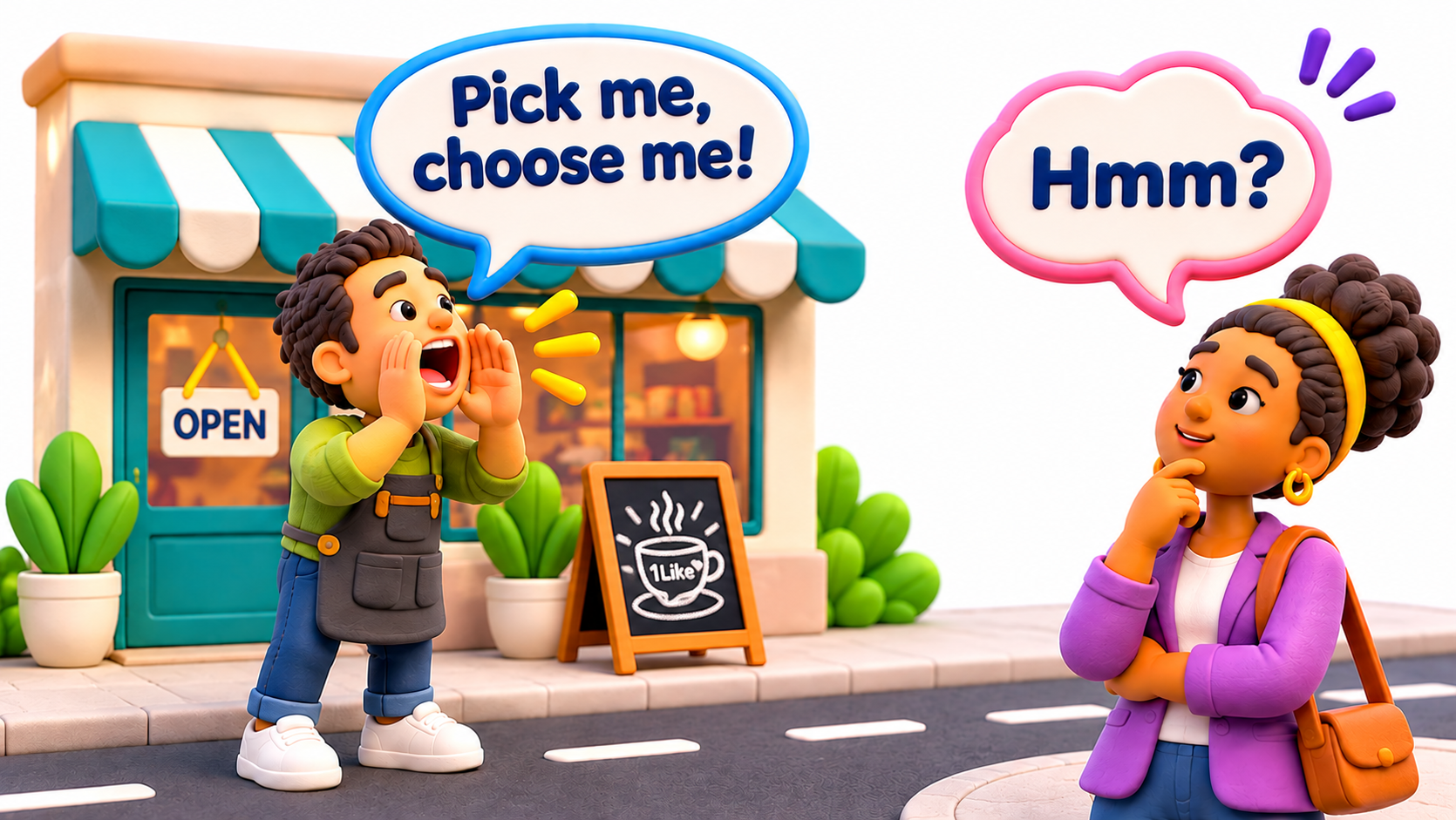
You know what makes your business special. But is it what your customers care about? Imagine someone asks you a perfectly reasonable question…
“Why should I choose your business?”
You probably have an answer. Perhaps you offer exceptional service, competitive prices, innovative solutions or an unwavering commitment to quality. All admirable qualities, although it’s remarkable how many businesses seem to have the same ones.
And then there’s the familiar promise: “We save you time and money.”
Which sounds wonderful. Who wouldn’t want more time and money? The trouble is that your competitors are probably promising the same thing.
So the question remains: Why you?
At this point, your brand may be having its Grey’s Anatomy moment: “Pick me. Choose me. Love me.”
The trouble is that customers still need a reason to do any of those things!
If we asked your customers why they chose your business, would they give us the same answer?
- “I chose you because you explained everything clearly and I knew what to expect.” This supports a business that believes clarity and service set it apart.
- “Honestly? You were the only one who answered the phone.” The business may be promoting its expertise, while customers value how easy it is to reach.
"Knowing your product exceptionally well isn't quite the same as understanding why someone would want to buy it."
Businesses spend considerable time deciding what makes them different. They develop brand messages, refine their offerings, and carefully explain why their products deserve attention. Yet somewhere in all that enthusiasm, an important perspective can get overlooked: the person who’s actually expected to buy something… And that person may have an entirely different idea of what makes your business worth choosing.
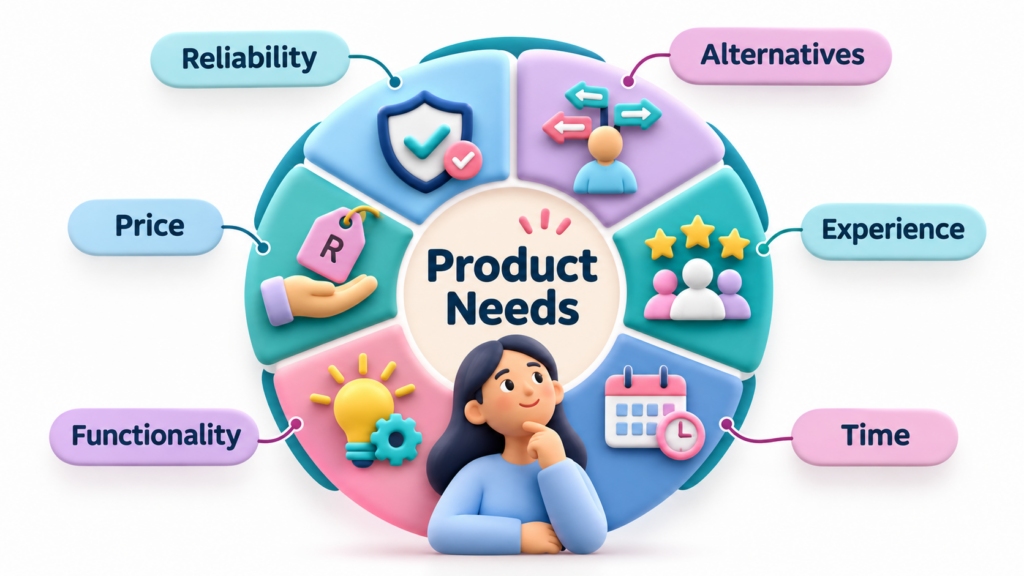
When Businesses Become Their Own Biggest Fans
There’s something understandable about business owners becoming attached to what they’ve created. They’ve invested time, money and probably a few sleepless nights getting everything right. They know their products, understand their services and can explain every feature they’ve worked so hard to develop.
The problem begins when that familiarity turns into an assumption that customers will appreciate the same things.
- Imagine a company selling accounting software. Its website proudly advertises advanced reporting capabilities, sophisticated dashboards and seamless integrations. The team has spent months developing these features, and they’re understandably excited about them.
- Meanwhile, a small-business owner visiting the website has a rather different concern. They’ve spent another Sunday evening wrestling with spreadsheets and would quite like to know whether this software could give them their weekends back.
The company is explaining what it has built. The customer is trying to work out whether it will make life easier.
Neither perspective is necessarily wrong, but there’s a gap between them. A feature that seems impressive to the people who developed it may mean very little to someone who doesn’t immediately understand its relevance.
Why You? → Your Customers Need → Can They Choose You?
This is where businesses can become their own biggest fans. They know so much about their offering that they sometimes forget what it’s like to encounter it for the first time… And knowing your product exceptionally well isn’t quite the same as understanding why someone would want to buy it.
"If you asked your customers why they chose you, would their answer sound anything like yours?"
Can You Answer “Why Me?” in One Sentence?
Here’s a small exercise that can reveal quite a lot about how a business understands its customers.
Imagine a potential customer is comparing your business with two or three alternatives. They have limited time, a problem they want solved and no particular reason to favour you.
Why should they choose your business?
Try answering in one sentence. Not a paragraph about your history, a collection of impressive adjectives or a mission statement that could comfortably belong to another fifty companies.
And not simply, “We save you time and money.”
Saving time and money is a benefit, but it doesn’t automatically explain why someone should choose you over another business offering the same promise.
Consider our fictional accounting software company.
- The business-centred answer: “We provide innovative accounting solutions with advanced reporting and exceptional customer service.”
- A more customer-centred answer: “We help small-business owners understand their finances without spending their weekends buried in spreadsheets.”
The second statement isn’t automatically a better message for every audience. Some customers may genuinely care more about advanced reporting or integrations. That’s precisely why understanding the customer matters.
The point isn’t to find a cleverer way of describing the same product. It’s to connect what the business offers with something its intended customers have a reason to value.
Your answer doesn’t have to be dramatic or revolutionary. A local business might win customers because it’s dependable, conveniently located or unusually good at explaining a complicated service.
Sometimes the most valuable difference isn’t particularly glamorous. It’s simply the thing customers have been struggling to find elsewhere.
But there’s a catch. You can’t answer these questions confidently through guesswork alone.
A beautifully written value proposition is still an assumption until you’ve checked whether it reflects what customers actually experience and appreciate.
Perhaps We Should Ask the Customer
Business owners naturally have opinions about what makes their businesses valuable. Those opinions are informed by experience, expertise and the effort they’ve invested in building something worthwhile.
But customers see the business from a different position. They notice what helps them, what frustrates them and what gives them confidence to choose one option over another.
So before rewriting your website or developing another marketing campaign, ask a few customers:
- Why did you choose us? Listen for the reason they give before offering your own.
- What mattered most when you were deciding? It may be something you rarely mention in your marketing.
- Was there anything that nearly stopped you? Their hesitation may reveal a concern future customers share.
- What other options did you consider? Find out what made your business feel like the better fit.
Their answers may confirm everything you believe about your business. They may also surprise you!
The One Like Insight: The real value of the one-sentence challenge isn’t simply explaining your business more clearly. It’s discovering whether you understand your value from the customer’s point of view.
If you asked your customers why they would choose you, would their answer sound anything like yours?
Final Thoughts
So, why should customers choose you?
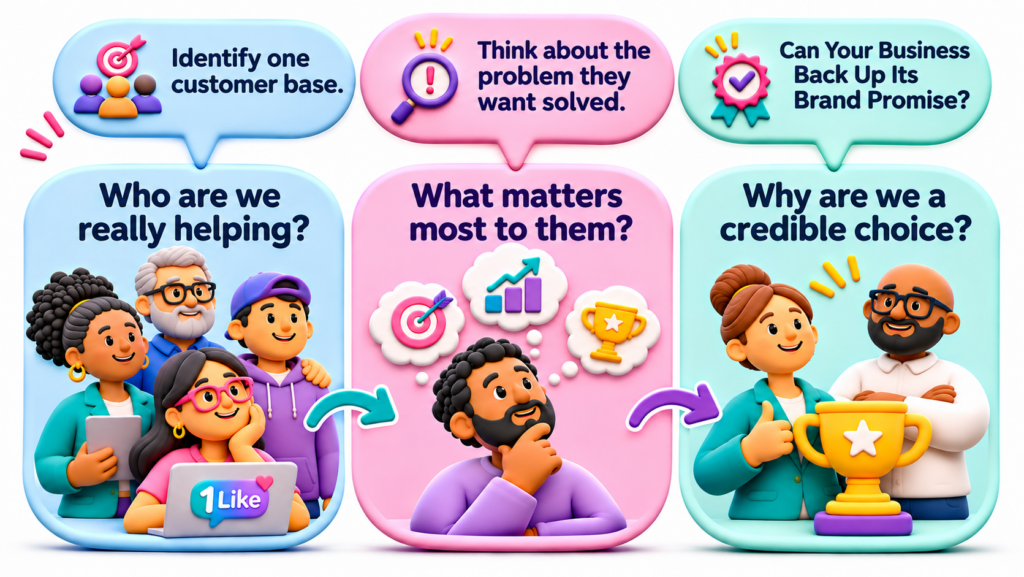
Can you answer in one sentence? “We take care of all your needs” sounds reassuring until you realise it could belong to almost any business. Say who you help, what matters to them and what you can genuinely deliver.
It doesn’t need to be a clever tagline. It needs to sound like your business and mean something to the customer reading it.
FAQ
Lets Recap!
Start with the customer’s problem, then explain the specific way your business helps. A useful answer names who you help, what matters to them and why they can count on you. It should sound like something you can demonstrate in practice, rather than a collection of adjectives that any competitor could use.
You do not need to invent a dramatic difference. Customers may choose you because you explain things clearly, respond reliably, make the process easier or serve a particular need especially well. Find out which of those things your customers actually value before making it the centre of your message.
It describes a benefit, but it is usually too broad on its own. Explain whose time you save, how you save it and what that means in their situation. A specific, believable benefit gives customers more to consider than a promise they have seen on dozens of other websites.
Ask them soon after they buy, while the decision is still fresh. Find out what problem brought them to you, which other options they considered, what mattered most and whether anything nearly stopped them. Listen for patterns across several conversations instead of treating one answer as the whole story.
Treat it as useful information, not a verdict on your business. You may need to explain the value of an important feature more clearly, or you may discover a strength you have been overlooking. The aim is to connect your expertise with what customers have a reason to care about.
One Like Research & Further Reading
- Bain & Company Article — Closing the delivery gap: How to achieve true customer-led growth
- Chip Heath and Dan Heath (HBR Article) — The curse of knowledge
- CEB Marketing Leadership Council — From Promotion to Emotion Connecting B2B Customers to Brands
- Gartner — B2B Brands Need to Rethink Their Content Marketing Strategy

