


Marketing discovery helps you find the real problem before choosing the tactic. Learn how research, customer insight and data turn assumptions into strategy.
Why good marketing starts by diagnosing the problem before choosing a tactic. The content looks good. The social posts are scheduled. The website is live. Someone has spent several evenings figuring out Meta Ads. From the outside, everything looks ready for marketing.
But then nothing much happens.
The immediate assumption is often that there is a marketing problem, so attention turns to the most visible parts of the campaign. Maybe it needs more reach, the creative needs changing, the business needs to post more often, or perhaps it needs SEO, paid advertising, TikTok, AI, email marketing or whatever tactic happens to be receiving the most attention that month.
- Sometimes the problem does sit at the tactical level.
- Sometimes marketing isn't the problem at all.
The problem started several decisions earlier. Before a campaign underperforms, there may already be weaknesses further upstream:
- The audience wasn't clearly defined, so the message is trying to speak to everyone and connecting properly with no one.
- The positioning was vague, so customers can see what the business sells but not why they should choose it.
- The offer wasn't strong enough, so more visibility simply puts an unconvincing proposition in front of more people.
- The pricing didn't match the market, creating friction that better creative cannot necessarily solve.
- The channel didn't match customer behaviour, so the business was showing up where it wanted to market rather than where its customers actually discover, research and buy.
- There wasn't enough evidence yet, so execution began before the business understood the problem it was trying to solve.
This is where marketing can become expensive very quickly, because when the problem hasn’t been diagnosed properly, every new tactic starts to look like a possible solution.
More content. More ads. Another platform. A website redesign. A new campaign. A new tool.
But adding more activity to the wrong problem doesn’t create strategy. It creates more activity. That is why I don’t think of marketing as a collection of tactics.
Think of it as a decision-making process.
Think of it as a decision-making process. the question isn't simply “What should we do?” It is “What problem are we actually trying to solve?”
The tactic should come later, once you understand what is happening, where the friction sits, what is influencing the problem and what actually needs to change, because good marketing isn’t about having more tactics to choose from. It’s about having enough insight to know which one is worth choosing.
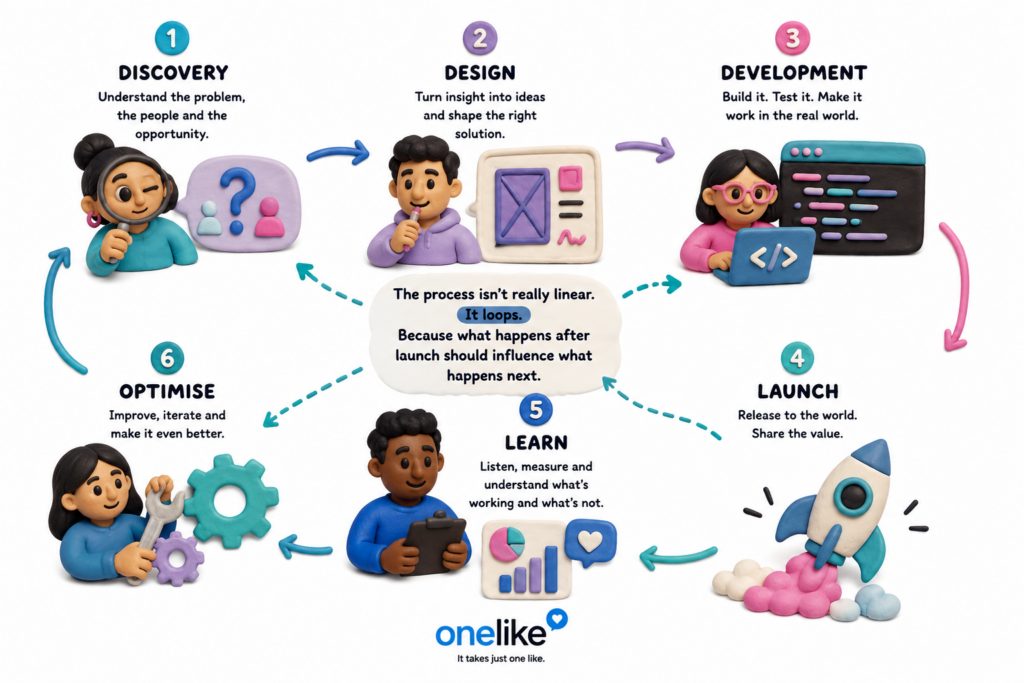
1. Discovery: Don't Start With Marketing
The first question shouldn’t be “What should we post?”
It should be “What are we actually trying to solve?”
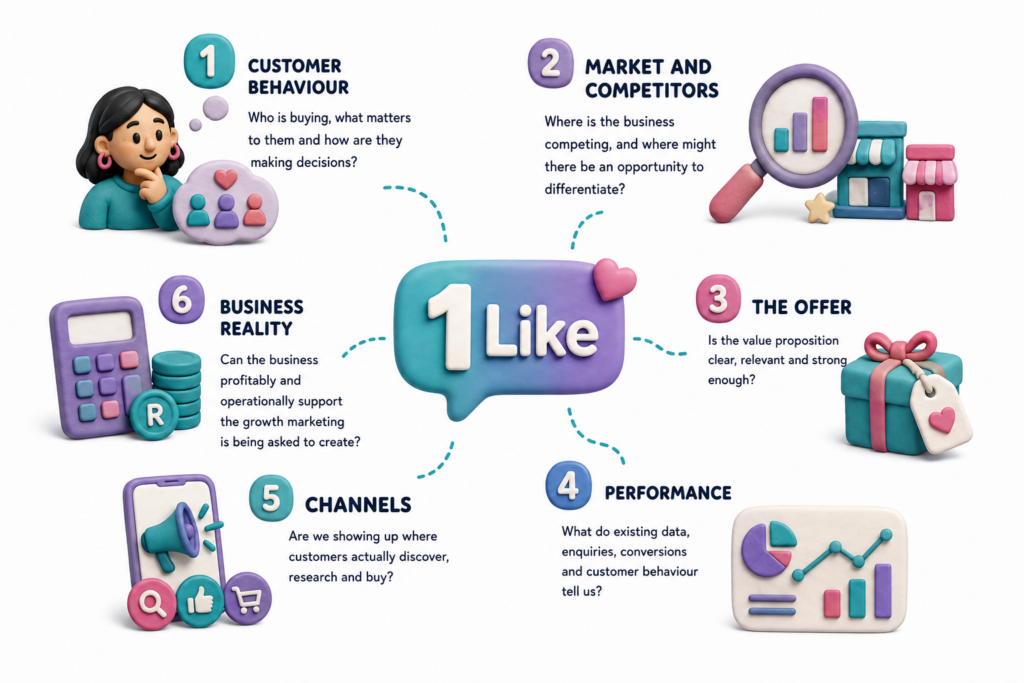
Discovery is where we investigate the business, the customer, the competitive landscape, the offer and the wider environment the business is operating in, because before deciding what marketing should do, we need enough information to understand where the opportunity or problem actually sits.
It sounds obvious. In practice, this is where a surprising amount of marketing gets rushed; businesses often arrive with the solution already selected:
- “We need social media.”
- “We need more leads.”
- “We need a new website.”
- “We need SEO. AIO. GEO”
- “We need to send out news letters.”
- “We need to run ads.”
But these aren’t diagnoses. They are proposed responses to a problem that may not have been properly investigated yet.
A business struggling to generate enquiries might have a visibility problem, meaning not enough of the right people are finding it. It might have plenty of visibility but a conversion problem, where people are finding the business but aren’t convinced enough to take the next step. Or customers might be converting perfectly well, while poor margins, pricing or operational capacity mean that acquiring more of them simply creates a bigger problem somewhere else.
From the outside, those situations can look remarkably similar. They require completely different responses.
Discovery prevents us from solving the wrong problem extremely well.
This principle reaches well beyond marketing. Management thinker Peter Drucker captured the same problem when he warned, “There is nothing so useless as doing efficiently that which should not be done at all.”
In marketing, that distinction matters. A team can execute brilliantly, produce excellent creative, optimise campaigns and publish consistently, but if it is responding to the wrong problem, better execution simply makes the wrong decision more efficient.
The symptom → The diagnosis → The right response.
The result isn’t research for the sake of research. It is a clearer picture of where the opportunity sits, what deserves attention and what doesn’t need doing yet, so that when a tactic is eventually chosen, there is a reason for choosing it.
Good discovery doesn’t give you more marketing to do. It helps you decide what is worth doing in the first place.
That means looking beyond the obvious symptom. Depending on the problem, discovery might examine:
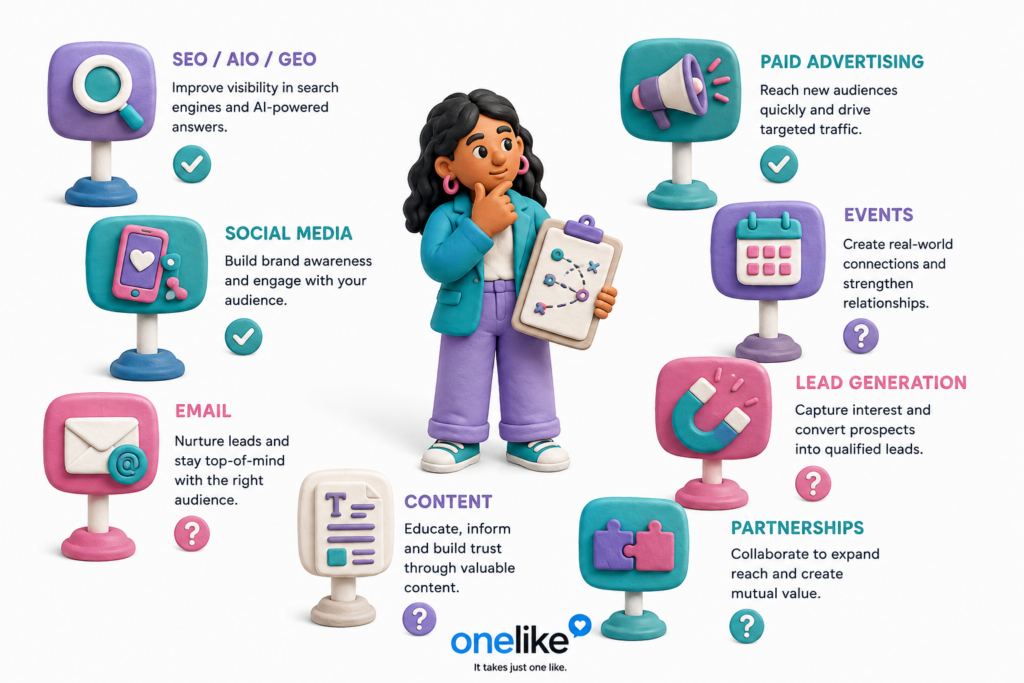
2. Design the Plan: Strategy Is built on insight
Once we understand the problem, we can decide what deserves attention.
That distinction matters because a marketing strategy shouldn’t simply be a list of everything a business could do. It should make deliberate choices about what the business should do, why it should do it and, just as importantly, what can wait.
- SEO, AIO and GEO
- Social media
- Email marketing
- Content
- Events
- Lead generation
- Partnerships
- Digital initiatives and emerging channels
Strategy requires choices → Discovery gives us the evidence → Strategy decides what to do with it.
A business can be active across every tactic and still have very little strategic direction. The question isn’t how much we can do, but what deserves our attention and why.
- Where is the customer?
- What problem are we trying to solve?
- Which channels make sense?
- What does the evidence tell us?
- What can the business realistically execute?
- What are we deliberately not doing yet?
More marketing activity ≠ More marketing strategy. Good strategy doesn't just decide what gets done. It decides what doesn't need doing yet.
3. Development: Execution Should Test the Thinking
Discovery helped us understand the problem. Strategy helped us decide what deserved attention. Development is where those decisions finally have to prove themselves.
This is where the visible marketing begins.
The campaign is created. Content is produced. SEO is implemented. Advertising goes live. Emails are built. Landing pages and web experiences take shape, and AI can help accelerate parts of the research, production, analysis and iteration.
But Development shouldn’t simply be the stage where the strategy gets “made.”
It should be where the strategy starts being challenged.
Until this point, we have been working with evidence, insight and informed assumptions. Development puts those decisions in front of the people they were designed for, and that is when assumptions start meeting reality.
- Does the message resonate?
- Are the right people paying attention?
- Do they understand the offer?
- Are they clicking, enquiring or buying?
- Where are they hesitating or dropping off?
- Are the customers responding the ones we expected?
- Are they coming back?
A strategy can look perfectly logical in a presentation, but customers never see the presentation. They only experience what we actually put in front of them.
They experience the ad, the email, the search result, the landing page, the offer, the service and every interaction surrounding it. They don’t know what the strategy intended, which assumptions informed it or what the creative brief said, and they don’t need to.
Customer behaviour tells us whether our strategy translated into reality.
Customer behaviour is what makes Development more than execution. It gives the assumptions made during Discovery and Strategy somewhere to meet the market, and when customers respond differently from what we expected, that isn’t simply a campaign problem. It is new information.
That information shouldn’t sit at the end of the process. It should become the beginning of the next decision.
Execution is where the strategy stops being an internal idea and starts becoming something the market can respond to.
Entrepreneur and Customer Development pioneer Steve Blank captured the principle neatly: “No business plan survives first contact with customers.”
The context is entrepreneurship, but the principle translates remarkably well to marketing. A plan contains assumptions about customers, behaviour, messaging, channels and value. Execution allows us to test those assumptions against what people actually do. That means Development isn’t simply about producing more content or launching more campaigns. It is about building deliberately enough that we can learn from the response.
What we thought → What we built→ What customers actually did.
The market doesn’t see the strategy deck, understand what the creative team intended or know why a particular channel was selected. It only experiences the result.
What happens next gives us something strategy alone cannot: evidence of how the thinking performs in the real world. The clicks, enquiries, purchases, drop-offs, questions and unexpected behaviours become signals we can learn from.
Execution, then, isn’t only where marketing gets produced. It is where the market starts giving us information back.
4. Launch & Optimise: Turn Response Into Direction
Launch is often treated as the moment the plan becomes complete.
The campaign is approved, the website is published, the ads are running and the emails have gone out. Everything Discovery uncovered, Strategy prioritised and Development built is finally in front of the customer.But launch doesn’t complete the thinking. It gives the market a chance to challenge it.
And when the response starts coming in, we need to know where to look. The dashboard tells us part of the story. The market tells us the rest.
- Analytics: What are people clicking, viewing, ignoring or abandoning?
- Conversions: Are people taking the action we expected them to take?
- Search behaviour: What are customers actually looking for, and is it what we anticipated?
- Sales conversations: What questions, objections and patterns keep appearing?
- Customer feedback: What are reviews, complaints and enquiries telling us?
- Retention: Are customers returning, renewing or buying again?
- Product behaviour: Why is one product selling while another barely moves?
- The wider experience: Are technical issues, slow pages, confusing journeys or unnecessary friction getting in the way?
- Market research: What can surveys, interviews, focus groups, social listening or further competitor research help us understand that behavioural data alone can't explain?
We launch → We listen → We learn → We decide what happens next.
Individually, these signals can look like separate marketing or business problems. Together, they help us understand not only what happened, but why it happened and what deserves to change next.
Sometimes that means adjusting the creative, message or channel. Sometimes it means revisiting the offer, customer journey or audience. And sometimes what we learn takes us all the way back to the beginning, because the evidence has challenged something we thought we understood during Discovery.
That isn’t going backwards. That’s the loop doing its job.
The end of one campaign should make the beginning of the next decision smarter.
Good marketing isn’t a straight line from idea to launch. It’s a loop where every response gives you more information for the next decision. We aren’t presenting four steps people complete once. You’re presenting a marketing decision system that gets smarter as it moves.
Final Thought: The Tools Change. The System Doesn't.
Marketing will keep changing. AI will change how content is produced, search will continue to reshape how businesses are discovered, platforms will rise and disappear, algorithms will shift and customer expectations will move with them. There will always be another tool, channel or tactic promising to make marketing easier, faster or more effective.
But new tools don’t remove the need for good decisions.
Underneath all that change, the questions that matter remain remarkably stable:
- Who are we trying to reach?
- What problem are we actually trying to solve?
- Why should someone choose us?
- What evidence informed the choices we made?
- What happened when those choices met the market?
- What did we learn from the response?
- What deserves to change next?
That is why I don’t think the strongest marketing process is:
Plan → Execute → Finish… It is:
Discover → Decide → Build → Launch → Learn → Improve → Discover again.
Because marketing isn’t a straight line towards a launch date. It is a system of decisions, assumptions, responses and learning, where each stage should make the next decision better informed than the one before it.
Sometimes the evidence will confirm what we thought. Sometimes it will tell us to adjust the message, rethink the channel or change the offer. And sometimes it will take us all the way back to Discovery because the problem we thought we were solving wasn’t quite the problem at all.
That isn’t starting over. It’s starting again with better information.
The tactics will change. The channels will change. The technology will definitely change.
But the ability to diagnose before acting, choose before doing, test what we believe and learn from what happens next will remain far more valuable than knowing how to use whichever tool happens to be trending.
Software architect Grady Booch captured the danger of confusing technology with capability rather neatly: “A fool with a tool is still a fool.” The tool can accelerate the work, but it cannot decide whether the work is worth doing in the first place.
The tools will keep changing. The advantage is knowing how to think before you use them. — One Like
Good marketing starts before the tactic.
When marketing underperforms, the instinct is often to add more activity. More content. More ads. Another channel. Another tool.
The first question shouldn't be “What should we do?” It should be “What are we actually trying to solve?”
Diagnose before you prescribe.
A visibility problem, a conversion problem and a weak offer can produce remarkably similar symptoms from the outside.
Insight should create choices, not a longer to-do list.
A business can be active across every tactic and still have very little strategic direction.
And perhaps more importantly: what are we deliberately not doing yet?
Execution should test the thinking.
Discovery helped us understand the problem. Strategy helped us decide what deserved attention. Development puts those decisions in front of the people they were designed for.
Execution isn't only where marketing gets produced. It is where the market starts giving us information back.
Launch doesn't complete the thinking.
It gives the market a chance to challenge it.
Clicks, conversions, drop-offs, traffic and performance.
Questions, reviews, sales conversations, repeat behaviour and market research.
We launch → We listen → We learn → We decide what happens next.
The tools change. The system doesn't.
Platforms will rise and disappear. Algorithms will shift. AI will change how work gets done. Customer expectations will keep moving.
Good marketing doesn't simply move forward. It learns its way forward.
FAQ
Lets Recap!
Marketing discovery is the process of investigating the business, customer, market, competitors, offer, performance and wider environment before deciding which marketing tactics to use. Its purpose is to understand what problem you are actually trying to solve before investing time and budget in a solution.
Discovery gives strategy something to work with. Without it, businesses can easily jump straight into SEO, social media, paid advertising, content or other tactics without knowing whether those activities address the real problem. Good strategy starts with evidence, not a predetermined list of tactics.
A marketing strategy determines where to focus, why it matters and what the business is deliberately choosing not to prioritise yet. Tactics are the activities used to execute those decisions, such as SEO, email, social media, advertising or content. A business can use plenty of tactics and still have very little strategic direction.
No.
AI lead generation tools can improve research, automation, personalisation, analysis and content production, but businesses still need a clear strategy, relevant offers, credible expertise and an effective sales process.
AI can make lead generation more efficient.
It doesn’t automatically make it effective.
Because launch creates new information. Once customers interact with a campaign, website, offer or piece of content, their behaviour can confirm or challenge the assumptions made during Discovery and Strategy. Those insights should feed back into the next decision, making marketing a continuous cycle of Discover → Decide → Build → Launch → Learn → Improve → Discover again.
One Like Research & Further Reading
Smart Insights — How can getting organized make marketing teams 397% more successful?
Research cited by Smart Insights reports that organised marketing teams are 397% more likely to report success. Published 2019.
Content Marketing Institute — B2B Content Marketing: 2025 Benchmarks & Trends
Useful support for the relationship between strategy and execution. 29% of surveyed B2B marketers rated their content strategy as extremely or very effective, while unclear goals and weak links to the customer journey were among the reasons strategies underperformed.
Semrush — AI Content Marketing Report for SMBs
Semrush’s 2024 research surveyed more than 2,600 businesses and reports that 68% of businesses using AI saw increased content marketing ROI, alongside 67% reporting improved content quality.
Steve Blank — Customer Development Manifesto
Supports the Development section’s argument that plans and assumptions need to be tested against real customer behaviour. Blank’s principles include “Validate Your Hypotheses with Experiments” and “No Business Plan Survives First Contact with Customers.”
Harvard Business Review — Big Data’s Human Component
Supports the closing argument that technology and tools do not replace human judgement. The article attributes the line “A fool with a tool is still a fool” to software architect Grady Booch.

